Automated Storage and Retrieval System: Making Every Warehouse Move Count
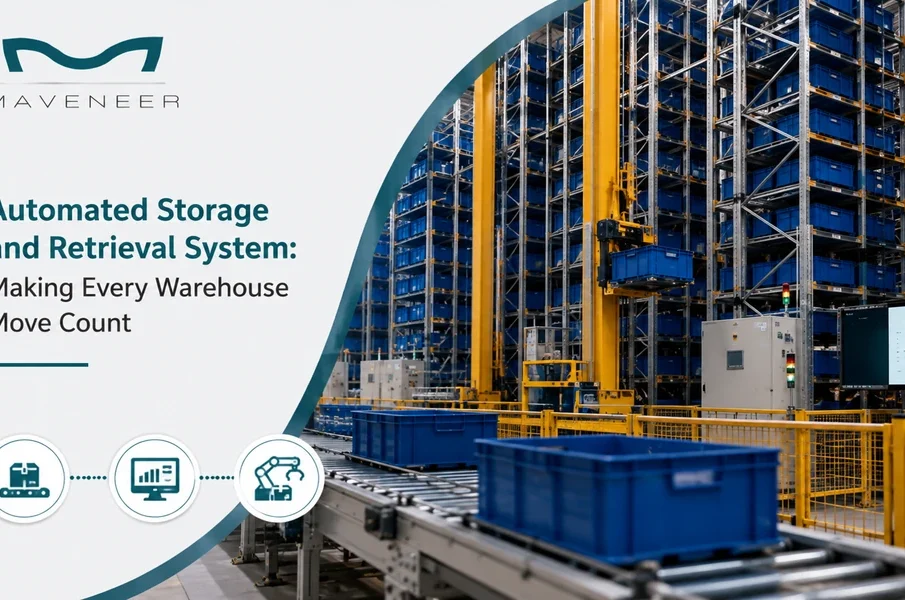
Even with ample storage space, a warehouse can still lose hours daily. Workers might trek through the warehouse or store to find an item, hunt for a product on the shelf or sit waiting as a machine completes a task. These slight delays can build as order volumes grow, becoming a costly waste.
Automated storage and retrieval system are another way to implement inventory. This involves fully automated mechanisms and software to take care of moving the goods with minimal manual use.
Think Beyond the Shelf
Traditional storage is mainly dependent on humans who search for products and move them. This works great with smaller operations, but larger facilities typically require higher speed and more controlled processes.
An automatic storage and retrieval system can move products into pre-specified warehouse locations and output them whenever they are required. It is a management tool that uses software to monitor internal inventory and manage the flow of goods.
Rather than having a worker search for a product, a worker can be given one automatically,
What Happens Inside the System?
It helps feel the basic, as a processing process in order.
1. Goods arrive
Using information such as barcodes or other tracking data to identify products, which all entered the warehouse.
2. A storage location is assigned
Each product is assigned with a storage location. It also controls where to stock and which area will be used for each product, based on the factors such as: space available (manual), conditions of products, and operational rules.
3. Automated equipment moves the goods
Automated equipment transports the goods. The products are moved to their places through cranes, shuttles, lifts, or conveyors and other machines.
4. An order triggers retrieval
Whenever something is needed a command is sent which reminds the software to retrieve the product.
5. The item gets to the space where it must go
For subsequent steps, it is brought to a picking, packing, or production site.
Where Automation Can Help Most
Automated storage and retrieval systems (AS/RS) aren’t just useful for cutting down random walking time.
It can be helpful for business improvement for the several different areas of warehouse operations:
- Space efficiency: Vertical storage can leverage the overall height of a building and use it to make better use of empty space.
- Stock management: Software gives where products are located.
- Optimized picking: Goods can come to workers rather than them having to go on lengthy searches.
- Operational consistency: Processes followed by automated movements.
- Workspace safety: More automation means lesser manual movements in the workplace and fewer physical tasks requiring lifted objects.
These benefits vary with the design of the system, as well as the product stored in the racking.
Before Choosing a System
Companies need to assess their inventory quantity, types of products, order-filling patterns, space capacity, and projected growth.
Integration also matters. The way it integrates with warehouse management software and other devices already in the facility should be effective.
A botched installation only adds new bottlenecks in place of those that have been removed.
Diagrams − More Structured Route from Storage to Dispatch
Storage can be transformed from a series of movements by hand into a stylized process through the use of an automated storage and retrieval system.
The integration of software, machinery, and organized inventory management enables businesses to perform better in the storage and retrieval process.
Automated approaches are increasingly paving a quicker and cleaner route from receiving to dispatch for operations facing space shortages, order volume growth, or labor demand concerns.




-
What Insurance Adjusters Actually Write Down After a Scranton Car Crash
I spent three years on the other side of the claims desk, ... -
-
-
-